

Choosing the right surfboards has always been a topic of debate. You've probably already searched the internet for a wide variety of beginner surfboards, trying to decipher advice from pros, surfboard shapers, forums, gurus, and that surfer friend who tells you about their experience. Each type of board has unique characteristics, and selecting the correct one is essential to improve your experience in the water.
The truth is that the right surfboards are those that fit each surfer's needs, such as their surfing level.
These are some aspects to consider when choosing the perfect surfboards for starting to surf:
- Skill Level: Your surfing skill level is key to choosing the right surfboard. If you are a beginner surfer, look for a board that provides stability and easy paddling. As you progress, you can opt for smaller, more maneuverable surfboards.
- Surfer's Size and Weight: Your weight and height are determining factors for board selection. The heavier you are, the more volume (width and thickness) you'll need in a board to provide adequate buoyancy. Buoyancy is essential for staying on the water's surface and making paddling easier.
- Wave Type: The wave conditions in your area also play a role. If you usually surf in small, gentle waves, a short, wide board might work well. In bigger, more powerful waves, you might need a longer, sturdier board for more control.
- Board Shape: Surfboards come in a variety of shapes and designs. Wide boards with a wider nose are ideal for beginners, as they offer stability. Thinner, narrower boards are suitable for more advanced surfers looking for maneuverability.
Which surfboard to start with? Personalized advice
At Flysurf, we have guided numerous beginners to find the ideal surfboard for their first experiences in the water. Most of them thank us and tell us about their progress. It all starts with a classic question: "Which surfboard should I start with?" Our answer is usually direct: "You need at least a 7-foot surfboard, wide, with volume, and little rocker." This type of board facilitates balance and paddling, perfect for your first steps in surfing without frustration.
That's the formula: there's no other way to learn. The classic advice from an expert surfer: "No, just buy a shortboard! If it's too easy, that longboard will only serve you for a while and then you'll have to change it."
This statement has no logical validity and is a result of that retrograde amnesia that occurs when you've mastered an activity. Believing it's very easy to learn even though it took you years, effort, and suffering to achieve.
Shortboards look very nice, are easy to transport, and look very "cool" when you get out of the water. But rest assured that your path to what we call "learning to surf" will be long, and you'll need a good dose of perseverance, patience, and tolerance for frustration.
Let's analyze the main aspects to consider when choosing your first surfboard:
Which surfboard to start with? Surfboard dimensions
Surfboard dimensions are directly related to its volume. A surfboard with more volume provides greater buoyancy, which will help you catch more waves. With more surface area on the water, the wave will propel you more easily, allowing you to stand up frequently and improve your posture, balance, and technique. Choosing the right volume for your board is key to progressing and making the most of each surf session.
Each joint in the human body has position receptors, which tell the brain its angle and location without needing to look at them. When performing an exercise and failing, the brain re-interprets these signals with each subsequent repetition and adjusts its movements through the muscles in response to these signals.
The result: standing up stably, adjusting your posture according to the board's position changes, and riding the wave without falling.
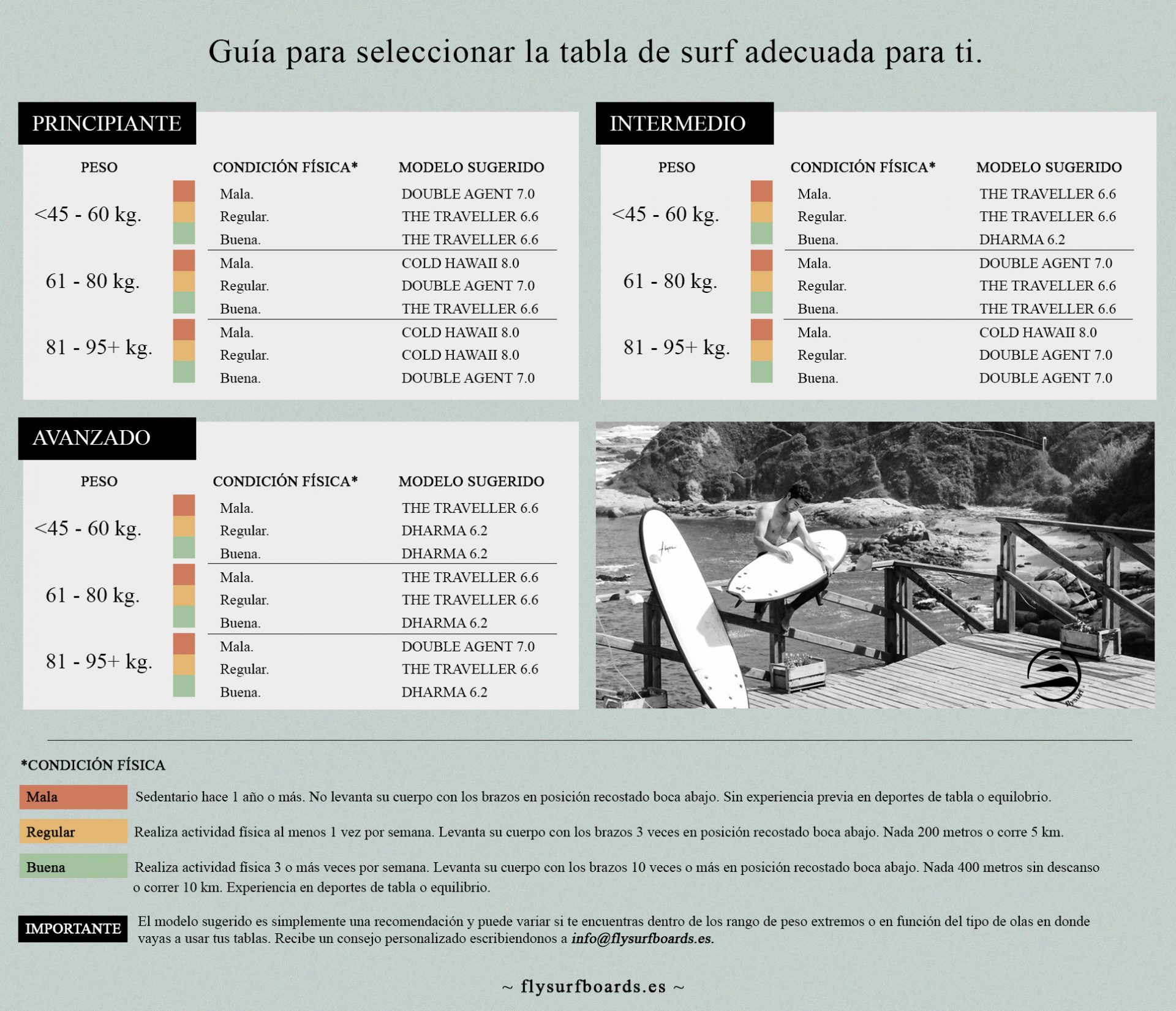
Which surfboard to start with? A wider board is better
But what is a wide board? Well, standard surfboard measurements range from 18 inches wide to approximately 24 inches on large longboards. A suitable surfboard width to start with is 21 to 22 inches wide. This measurement will give you stability and also control.
You'll be able to stand up first in the foam stably, until you get used to the feeling; then you can venture into small waves that break near the shore, always trying to paddle and stand up before the wave breaks and turns into foam, that's what we call "the face" of the wave. We leave you a guide to understand the phases of the wave and get the most out of your board.
Which surfboard to start with? No more than 8 feet
We are talking about people of average height and weight in Spain. If you are between 1.60 and 1.90 meters tall or weigh between 50 and 90 kg, you are within the parameters to learn to surf on a surfboard of at least 6.8 feet but no more than 7.5. But why don't we use very large boards with a lot of volume to catch many waves?
The answer is simple: After surfing a couple of waves with those types of boards, where you'll surely stand up and have a good time, you'll realize they are heavy, difficult to maneuver, and transport out of the water.
This is where the concept of the "one-day surfer" comes from. This character is the typical person who goes to the beach and suddenly becomes interested in surfing, approaches a school, takes a class, and stands up 5 times in the foam, only to return home and never think about surfing again.
For this person, a large board is great: easy paddling, easy take-off (standing up), and not having to transport it back home – perfect! But YOU are a person who is passionate about the sea and has a real interest in learning and progressing, and you don't have money to buy new surfboards every two months.
That's the reason why we recommend that the ideal surfboard dimensions for learning and progressing are between 6.8 feet and 8 feet, offering the perfect combination of utility and practicality.

Surfboard material: essential accessories
Surfboard accessories or materials are essential for any surfer, as they contribute to safety, performance, and comfort in the water. Here is a list of essential surfing accessories:
Surfboard material: fins
Fins are essential components of a surfboard, and they play a fundamental role in the board's performance and maneuverability in the water. Here is key information about fins in surfing:
- Single Fins: these are single fins located in the center of the tail of the board. They are common on longboard style boards and provide a more classic and smooth surfing feel.
- Thruster Fins (Three Fins): the thruster design is the most common in modern surfboards. It consists of three fins, one central and two side fins. The side fins help with stability and control, while the central fin contributes to direction and maneuverability.
- Quad Fins (Four-Fin): this design uses four fins, two in the front and two in the back. They offer increased speed and can provide a smoother turn than thrusters. They are popular on small surfboards and in faster wave conditions.
- Multifin Fins: some more advanced surfboards may have five or more fins. These designs are intended to offer specific performance in certain wave conditions and surfing styles.
In our surf shop, we have fins for you!
Surfboard material: surfboard bags
Protective surfboard bags are essential for keeping your board in good condition and protecting it from damage during transport and storage.
These bags are available in a variety of materials and designs to suit different needs and budgets. In our online store, you will find surfboard bags and other types of surfboard materials.
If you want more information on how to choose your first surfboard, check out our catalog of surfboards and let us advise you. See you in the water!


